Saturday, April 5, 2008

Waterloo!

Expelled, the Musical is about to hit theaters! In theaters across the country! Well, in a few theaters. This has inspired creationist mathematician and philosopher William Dembski to fire up his prognostication machine!

Hmmm... try these predictions on for size.

A controversial documentary set for release nationwide April 18 could foster a cultural shift "equivalent to the fall of the Berlin Wall," says William Dembski, research professor of philosophy at Southwestern Baptist Theological Seminary.
Wow! The fall of the Berlin Wall, that's huge! Bill Dembski has a long run of predictions. He made a prediction during the trial in Dover, Pennsylvania. What did he say about that?
As a consequence, this [court] case really could be a Waterloo for the other side.
Waterloo! Berlin Wall! Hmmm... He might do well to read a little more Twain:
The reports of my death have been greatly exaggerated.
Mr. Dembski, please get back to work, and publish some papers that have data in them. Really. Movies and court cases don't make creationism intelligent design a science. Data, Mr. Dembski. Data. If you're interested in what it looks like, try this little search on evolution.

Digg!

Friday, April 4, 2008

Westboro Baptist Church Rickrolled!

The Westboro Baptist Church is a group of hatemongers, frequently written up by the Southern Poverty Law Center. They're quite a nasty group of folks. They show up at any prominent funerals, saying that the death of these people is due to America's tolerance of homosexuals. The odd part is that these hatemongers seem to not care whether the deceased people are homosexual or not. It just matters whether or not the news media are there to cover it. They've made themselves notorious by promoting their slogan "God hates fags", and by suing anyone who offends them. I try to avoid calling whole groups of people nasty, but these folks are really hideous. To get an idea of the lengths these weirdos take, see this article:

The [Westboro Baptist Church family] don't just picket, they also fax. And what faxes. Sent out to dozens of government offices, law firms, businesses and homes across Kansas several times a week, the faxes are grotesque, non-stop political commentary lambasting local and national figures.

Minnesota Sen. Paul Wellstone is a "bug-eye faggy baby-killer." Sailors in the U.S. Navy are "blasphemous fag beasts." Jerry Berger, the Vintage owner, is a "[b]loody Jew... merchant of anal copulating."

Joe Lieberman, Al Gore's Democratic running mate last fall, is "an anti-Christ Jew" who "has sold his soul to fags." Elizabeth Taylor is "an evil woman" who led a "wicked, Christ-rejecting, Satan-worshipping life." Jesse Jackson is a "fag" and a "black Judas goat leading his people to hell."

Thanksgiving was established as a "pagan feast" so the Massachusetts governor could "lust after the semi-naked bodies of the Indians he invited." Poet Maya Angelou is the "filthy face of fag evil."

Maya Angelou as a face of evil? What? Wow. Okay, so if you find that offensive, please donate money to the Southern Poverty Law Center. (Mrs. Factician and I give them money twice a year). And after you're done, watch this guy do an in-person Rickrolling of a Westboro Baptist Church protest. Bravo, dude.


Westboro Baptist Church gets Rick Rolld - Watch more free videos

Digg!

Tuesday, April 1, 2008

Lab meeting

So I just had lab meeting. A 5th year graduate student was presenting her work on mutational analysis of one of the proteins we study. An interesting lab meeting, but not normally noteworthy for the blog. (I reserve this blog for only the most important events in my exciting life - see Death Star Troofers, below).

So I'm quietly enjoying my coffee, my mind wandering away from the introduction (I've heard it too many times over the last five years) and I hear a voice from the back of our darkened conference room, "Balderdash! I'm going to Expel you from science, because I think your model for DNA rearrangments is absolute crap! Consider yourself Expelled!"

I just couldn't believe it! Apparently PZ Myers gatecrashed our lab meeting! He really does have a problem!

Digg!

Monday, March 31, 2008

Goddidit!

One of the predictions of creationism intelligent design is that the hand of God the intelligent designer will be found in creation in the Design.

Well, I have finally found it. And wouldn't Behe be impressed, I found it in Plasmodium yoelli, a malarial parasite that infects rodents. Just like Craig Venter, who inscribed his name into the organism that he designed, God the Intelligent Designer placed his watermark on the chromosome of that totally improbable rodent parasite, Plasmodium. Are you ready? This is what he wrote:

HEDIDIT
It's found in the impossibly large hypothetical protein PY01329 in Plasmodium yoelli. GodThe Disembodied Telic entity has marked his work in there. And he did it *before* Craig Venter did it. And in the 3rd person. So there.

(Note: Searches for GODDIDIT so far haven't found any perfect matches, but give me time and a few more genomic sequences, and we'll find it)

For those folks totally lacking a sense of humor - I'm being sarcastic. While this sequence of amino acids is in the genome of the Plasmodium parasite, it is not an indication of God'sthe Designer's hand.

Digg!

Friday, March 28, 2008

Friday beautiful science

Today's Friday Beautiful Science comes from the University of Maryland Biotechnology Institute. They're genetically engineering mosquitoes, with the hopes of making a malaria resistant mosquito. See more pictures here.

Digg!

Thursday, March 27, 2008

83rd Skeptics' Circle


This week's Skeptics' Circle is up at Mike's Weekly Skeptic Rant. Go have a gander, and win Ben Stein's Knickers!

Digg!

Tuesday, March 25, 2008

Please, pretty please, read my blog?

An Open Letter to PZ,


funny pictures

I'm just begging for more traffic. It's worked for others, why not for me?

Digg!

Deathstar Troofers Unite!

Deathstar troofers:

We’ve all heard the “official conspiracy theory” of the Death Star attack. We all know about Luke Skywalker and his ragtag bunch of rebels, how they mounted a foolhardy attack on the most powerful, well-defended battle station ever built. And we’ve all seen the video over, and over, and over, of the one-in-a-million shot that resulted in a massive chain reaction that not just damaged, but completely obliterated that massive technological wonder.

Like many citizens of the Empire, I was fed this story when I was growing up. But as I watched the video, I began to realize that all was not as it seemed. And the more I questioned the official story, the deeper into the rabbit hole I went.

Digg!

Saturday, March 22, 2008

Death strike to my naiveté

I don't like to think of myself as naive. Who does? But this has been an eye opener for me.

When I first started following the evolution/creationism 'debate', I thought that the creationists were merely mistaken. I was raised a Christian, and while my immediate family aren't biblical literalists, many of my aunts and uncles are. I understand these people. I was raised as one of them. And I discovered, through science, that many of the suppositions that these people hold are incorrect.

That said, I assumed that all creationists were merely incorrect. I didn't like folks who railed against the dishonesty of creationists. After all, many of my family are creationists, and I don't think they're dishonest.

But professional creationists are of a completely other breed. These people lie for a living. If you doubt it, take a look at the recent movie "Expelled". It's a movie that portrays creationists as martyrs to an unkind establishment (see quote at the top of my blog about unkind establishments). Currently, they're offering free showings of this movie to the public, all you have to do is sign up on their website. It's free. I've been thinking of going. The only restrictions listed are:

Please fill out one entry form per attendee. Once confirmed, your name will be on a list at the door of the theater. IDs will be checked.

For security, no bags, cell phones, or recording devices of any kind will be allowed into the theater. Please leave them in your car.
That's it. Recently, PZ Myers registered to go, and then was stopped at the door, and told he couldn't enter. Juvenile, right? Fine. His guest, Richard Dawkins, was allowed in.

Look what professional creationists say about it:
Amazingly, the best selling Oxford scientist/author Richard Dawkins also crashed a showing of Expelled in Minnesota last night
Crashed? Crashed? Come on, he registered and showed his ID at the door.
Dawkins apparently acknowledged that he had not been invited and did not have a ticket. A sophomoric side to his ideological campaign is thus revealed.
He acknowledged he wasn't invited? Likely none of the other people were either. You can register to go on their website. Are you trying to be dishonest?

When even little details like these get twisted and embellished, one wonders what credibility they have at all.

Digg!

Friday, March 21, 2008

Expelled, the musical!

Okay, this deserves all kinds of linkage. It contains humiliation! Armed guards! Nazis! (No, really, it contains Nazis. Well, it contains footage of Nazis). The makers of the pseudo-scientific "Expelled" movie tossed PZ Myers out of the movie (and he's even a subject in the movie!). Or, rather, they Expelled him. Oh the irony! Very funny! Read it! Link it! This deserves to be widely read!

Digg!

Friday beautiful science

Okay, I've been doing a lot of astronomy photos for my Friday's, but it's only because those damn astronomers have been pumping out all kinds of great photos. This photo comes from the Cassini probe. From the Jet Propulsion Lab:

Cassini's March 2008 flyby of Enceladus was designed to directly investigate the ongoing plume activity at the moon's south pole, but the path of the spacecraft allowed investigation of older evidence for internal activity near the north pole.

Compared to much of the moon's southern hemisphere—the south polar region in particular—the north polar region is much older and covered with craters. These craters are captured at different stages of disruption and alteration by tectonic activity and probably past heating from below. Many of the craters seen here are sliced by small parallel cracks that seem to be ubiquitous throughout the old cratered terrains on Enceladus. The mosaic also shows a variety of impact crater shapes, some with bowed-up floors and smaller craters within, very likely indicating that the icy crust in this area was at some time warmer than at present. While this conclusion was previously reached from NASA Voyager spacecraft images, these new data provide a much more detailed look at the fractures that modify the surface. This data will give a significantly improved comparison of the geologic history at the satellite's north pole with that at the south pole.
Hat tip to Emily.

Digg!

Friday, March 14, 2008

Friday beautiful science


Today's Friday beautiful science comes from an 5200-year old Assyrian bowl, with the oldest known moving animation:

The artefact bears five images depicting a wild goat jumping up to eat the leaves of a tree, which the members of the team at that time had not recognised the relationship between the pictures.

Several years later,Iranian archaeologist Dr Mansur Sadjadi, who became later appointed as the new director of the archaeological team working at the Burnt City discovered that the pictures formed a related series.
I wasn't able to upload the movie (darn blogger) I was able to convert the movie to an mpg, Blogger still hates this movie, but you can watch it in it's original form at Millard Fillmore's Bathtub or the Circle of Ancient Iranian Studies. Very cool!

Digg!

Thursday, March 13, 2008

Science is a crazy business.

What a strange business this is: We stay in school forever. We have to battle the system with only a one in eight or one in ten chance of getting funded. We give up making a living until our forties. And we do it because we want to help the world. What kind of crazy person would go for that?
Nancy Andrews, M.D., Ph.D.
Dean, Duke University Medical School

Via Orac, I learned of this new lobbying effort to increase NIH funding. Brokenpipeline.org argues that a generation of researchers will be lost if we don't fix the NIH. They're right.

Currently, universities aren't hiring new researchers. They're poaching researchers from other universities. So folks in a position like me, where they're finishing a post-doc, and starting to look for work, are in the position that there are no new jobs available. It's a crazy time. Read more here.

Digg!

Wednesday, March 12, 2008

82nd Skeptics' Circle.

The 82nd Skeptics' Circle is up at Happy Jihad's House of Pancakes. Go take a gander.

Digg!

Sex Conspiracy!


political statement?
Originally uploaded by kerusdotorg
Okay, this isn't really relevant, but it made me laugh, and is in reference to the Larry Craig scandal.

(Cue Eliot Spitzer jokes for fair and balanced joking).

(Edited for clarity).

Digg!

Monday, March 10, 2008

John McCain is anti-science.

I wrote last week how John McCain has no plan for science. This week, we discover via the Washington Post that he points to basic science studies as a waste of money:

The federal government, he declares with horror and astonishment, has spent $3 million to study grizzly bear DNA. "I don't know if it was a paternity issue or criminal," he jokes, "but it was a waste of money."
Head over to the Washington Post for the whole story.

Digg!

Oklahoma turns to relativistic, post-modern theocracy

The Oklahoma state legislature is in the process of passing a bill that codifies a student's right to remain ignorant - so long as they have a religious reason for doing so.

From ERV:

The bill requires public schools to guarantee students the right to express their religious viewpoints in a public forum, in class, in homework and in other ways without being penalized. If a student’s religious beliefs were in conflict with scientific theory, and the student chose to express those beliefs rather than explain the theory in response to an exam question, the student’s incorrect response would be deemed satisfactory, according to this bill.
Yow. So as long as you say your God told you that 1 + 1 = 3, you get to have the right answer.

From the actual text of the bill, HB2211:
Students may express their beliefs about religion in homework, artwork, and other written and oral assignments free from discrimination based on the religious content of their submissions. Homework and classroom assignments shall be judged by ordinary academic standards of substance and relevance and against other legitimate pedagogical concerns identified by the school district. Students shall not be penalized or rewarded on account of the religious content of their work. (my bold)
I think Oklahoma's in for some good, old-fashioned grade inflation.
"No, all of my answers on all of my tests are divinely inspired. I get an A+"
I can't wait until some Buddhists, Sikhs and Rastafarians sue for their right under this law to answer their own creation stories in science class. I find this bill *very* funny.

Clearly, the good Oklahoma Legislature isn't busy with anything important.

Digg!

Teach the controversy!

It's a conspiracy!

Digg!

Friday, March 7, 2008

Friday beautiful science

Today's Friday beautiful science is us. Here's a shot of our tiny little planet, as seen from Mars. The High Resolution Imaging Science Experiment (HIRISE) is orbiting Mars:

Launched in August 2005, the High Resolution Imaging Science Experiment (HiRISE) is flying onboard the Mars Reconnaissance Orbiter (MRO) mission. HiRISE will investigate deposits and landforms resulting from geologic and climatic processes and assist in the evaluation of candidate landing sites.
But in this particular image, they've pointed their cameras at earth to get a shot of the earth and the moon.

As an aside, I wanted to put this shot down as the Friday beautiful science this week, but Mrs. Factician thinks it's too difficult to look at. I'll let you be the judge.


This is another shot taken by the HIRISE. It's catching an avalanche in real time. The top of the mountain is on the left side of the photo, sloping downwards to the right. Those clouds to the right are dust thrown up by the avalanche. Absolutely beautiful. This photo is false colored.
Material, likely including fine-grained ice and dust and possibly including large blocks, has detached from a towering cliff and cascaded to the gentler slopes below. The occurrence of the avalanches is spectacularly revealed by the accompanying clouds of fine material that continue to settle out of the air. The largest cloud (upper images) traces the path of the debris as it fell down the slope, hit the lower slope, and continues downhill, forming a billowing cloud front. This cloud is about 180 meters (590 feet) across and extends about 190 m (625 ft) from the base of the steep cliff. Shadows to the lower left of each cloud illustrate further that these are three dimensional features hanging in the air in front of the cliff face, and not markings on the ground (sun is from the upper right).
Wow.

Digg!

Wednesday, March 5, 2008

If McCain wins, science loses.

I'm a post-doctoral fellow at a large medical school in the U.S. I'm looking for a 'permanent' position for me to conduct research. These positions largely don't exist.

The National Institutes of Health (NIH) are the largest organization for funding basic biomedical research in the United States. If you want basic research done, these are the folks who pay for it. The NIH budget hasn't been keeping up with inflation over the last few years. The purchasing power of the NIH has decreased every year. That said, funding rates for new grants are going down. My wife's advisor, who is one of the top 3 scientists in his field, failed to get a grant renewed that he has had for nearly 20 years. It's a tough funding situation, and basic scientists are the first to feel the crunch.

Here's the way getting a job as an assistant professor usually works: After successfully interviewing for a position, the department offers you a startup package. This startup package is money that belongs to the department, and in my field, ranges from $500,000 to $1 million. For the department, this represents a fairly substantial investment in you (for which they will expect returns). The money is used to buy new equipment and hire people to work for you while you try to get grant support from the NIH (or any other organization that is hiring). The department will get a cut from your grant, so this is why it is an investment for them.

Currently, many universities see this as too big a gamble. The funding situation is so bad, that many new investigators will fail to get a grant, and the departments know it. So to hedge their bets, many new research positions are requiring that you have a grant before you apply for the position. But, the NIH doesn't allow temporary trainees (post-docs) to apply for grant money. But universities are mostly only hiring people who have a grant. But you need a permanent position to get a grant.

That's some catch, that Catch-22.
Here's where things get even trickier. I'm currently paid by the Howard Hughes Medical Institute. They will only pay post-docs for 6 years. So in January, I'm out of a job. I need to find a permanent position in the next 10 months. Anyone who is nearing the end of a post-doc position is this funding era will have a *very* hard time finding an academic job.

So, what does this have to do with McCain? Clinton and Obama both have explicit science policies that they describe on their web pages. Here's the first three of Clinton's science points:
1. Establish a $50-billion Strategic Energy Fund.

2. Increase the basic research budgets 50% over 10 years at the National Science Foundation (NSF), the Department of Energy’s Office of Science, and the Defense Department.


3. Increase the NIH budget by 50% over 5 years and aim to double it over 10 years.
Here's a short excerpt of Obama's:
Double federal science and research funding for clean energy projects, relying on the resources and ability of our national laboratories, universities and land grant colleges.

Barack Obama supports doubling federal funding for basic research, changing the posture of our federal government from being one of the most anti-science administrations in American history to one that embraces science and technology.
Here's McCain's:


Oh. He doesn't have one.

If John McCain wins, and we continue starving the NIH, there will be a whole generation of post-docs who will complete their training to find no jobs available for them. And all of their ideas, and all of the science they would have done will be moved elsewhere (either to other countries, or into industry). All of the biotech companies that would have been started, all of the basic science that could be done, and all of the young, fresh ideas that could be hatched will be moved elsewhere.

Digg!

Friday, February 29, 2008

Friday beautiful science

Today's Friday beautiful science is a shot of a fruitfly (Drosophila melanogaster) larva trapped in a water droplet. From the Nature website:

This image of a live Drosophila larva in a water droplet has won the photographic competition that forms part of celebrations marking the 200th anniversary of the Royal Netherlands Academy of Arts and Sciences (KNAW). Winner Robert Markus, of the Biological Research Center of the Hungarian Academy of Sciences in Szeged, received the award at a ceremony on 25 February in Amsterdam.

...

Markus took his photograph to show how blood cells affect the fruitfly's immune system. "By identifying blood-cell-specific genes, we can generate transgenic Drosophila strains in which the blood cells express green fluorescent protein, so that they are visualized in vivo, making in vivo research possible on the immune system," he explained.
If you know Dutch, head on over to the prize website, and check out more info.

Digg!

Thursday, February 28, 2008

Quote of the Day

via Bug Girl's Blog:

“Getting an education was a bit like a communicable sexual disease. It made you unsuitable for a lot of jobs and then you had the urge to pass it on.”

-Terry Pratchett, Hogfather
My own thoughts are that a career in science is a lot like heroin. It's sure a lot of fun, but it fucks you up pretty royally.

For more, see Bug Girl's Post that Academia is a Cult.

Digg!

A Leap Year Skeptics' Circle

It's late at night, and dark. The scene is a little different than the last time a Skeptics' Circle was hosted by the Conspiracy Factory. Oh yes, it's rather a lot different.

A few days after the lunar eclipse, the day before February 29th, is the perfect day to observe some evil. You're hidden in the bushes, in the dark. Peeking over the hill in front of you, you can see a small group forming at the base of the hill. It's a group of men and women in black suits, carrying torches, and they're filing towards what looks like a circle of barrow mounds. They're not speaking. They're preparing to meet the Master.

They quietly file into the circle; it's quite easy to make them out, as their torches are putting off a fair amount of light. They stand in a circle. They wait. You wonder what they could be waiting for, but they're not saying anything.

One by one, they start to fidget. One of them shifts his weight from one leg to the other. And they start to whisper to each other in hushed voices.

"Where's the Master?"

"The last Skeptics' Circle was compromised. People witnessed it. It was all over the internet. I'm sure that the Master is ensuring that no such thing happens again."

"Oh."

There's an awkward silence.

"I met a girl on the internet."

"Again? Is it another Russian bride?"

"No. This is the real deal. She's from Thailand."


"Shhhhh."

The circle of men in suits stop fidgeting. There's a low howling noise.

"What the hell was that?"

"Maybe something trying to force its way into our world."

There's a small pinpoint of light in the middle of the circle that slowly tears open into a bright doorway. There's a sound of rushing air, and the Master steps through.

"Welcome, Master.", they all chant in unison.

"What is the first order of business?" he croaks.

"Oprah." one of the men squeaks. "She's teaching women how to be more manly. Letting them know that they're weak."

A woman steps forward, "I'll take care of it. I'll discredit her survey, and make it look ridiculous."

"Excellent, Rebecca." the Master croaks, "What is next?"

"Well, Master," says another suited man, "We always have the problem of magic medicine. They cure too many diseases, and siphon away our profits."

"Crush them."

"We'll put archaeologyknits on it."

"What about the anti-vaccine crusaders? Which of our pharma-shills is discrediting them?" croaks the Master.

"Pal MD"

"Excellent. Give him more stock options in Pfizer and Merck. What have we done with that super secret satellite that the Troofers put up to spy on our activities?"

"We've had to shoot it down. We've mostly discredited any other hypotheses. "

"Very good."

Another man steps forward, (are the men clones? they all look the same?) "We've started a project to get people to buy more stuff. It uses some reverse psychology to get folks excited about free stuff. Then we fleece them."

"Excellent, you will be rewarded." The Master pauses, "While we're talking about making good little consumer sheep out of the American public, you know what our biggest competitor to selling stuff is? Sex. Sex is free, and people having sex are not shopping, so we need to work harder to make sex boring and plain. We will pathologize sex. "

"Yes, Master. We're still in phase I, pathologizing fetish sex. When we're done with that, we'll pathologize all sex."

"Excellent." croaks the Master.

"But Greta Christina [in 2 parts] is on to our plan."

"Finish her."

The clone smiles, then quickly looks more somber and continues, "Someone figured out our old deal about the X-raying kids feet to fit shoes."

"Did he figure out about the alien implants?" asks the Master

"Not yet."

"Keep an eye on him. If he gets closer to the truth, finish him." Again he pauses. "How are we doing on getting our training manual out for new agents?"

"Very well, Master. I've written Part One, and I'm working on the next part."

The Master makes a clenching motion, and the clone falls to his knees clutching his throat. The Master growls "GET. OFF. YOUR. ARSE. AND. WRITE. PART. TWO." He releases his grip, and the clone falls to the ground, gasping for air.

"Yes, Master."

"Ahem." another clone speaks, "I'm also writing a part of the manual. But, I'm mostly done my part. No need for the crushy, necky, thing. I'll need my neck in two weeks when I host the next Skeptics' Circle. You can get directions from my blog, or e-mail me (Bing McGhandi) littletinyfeardemon self-circling-a-thing yahoo spot com. I would greatly appreciate it if you left my neck alone, Master, sir."

"Very well." says the Master. "You're safe. For now."

And with a flash of light he is gone. The clones look at each other, amazed that there have been no deaths at this meeting (and perhaps a touch disappointed). And with that they file out. As they file out, one of the clones says, "I wonder what we should do with this fellow?" He points to a file folder labeled Beef. "Is he one of ours?"

They continue to walk up over a barrow hill, and disappear from view.

And you are left alone on the hill, wondering if you really saw what just happened.

---

Edit added later: Two links that I never received (perhaps caught up by my spam filter? lost in cyberspace? *cue Vader music* stolen - by them?)

Bug Girl's Blog

and

TANK Vodcast

Sorry, to those of you I missed, it's likely due to the fact that the Skeptics' Circle was assigned to me after another host dropped out at the last minute.

Digg!

Tuesday, February 26, 2008

Skeptics' Circle reminder

A reminder to folks that I'm hosting the Skeptics' Circle this week. Please send your best skeptical posts of the last 2 weeks to me (factician at gmail period com) with the words "Skeptics Circle" in the subject line. If I get your posts before 6 p.m. ET on February 27th, I will do my best to include it.

Digg!

Friday, February 22, 2008

Friday beautiful science


Today's Friday beautiful science is another shot of Mercury from the Mercury Messenger. The Planetary Society has an awesome blog where they describe this shot:

MESSENGER took this photo of Mercury as it departed from its first flyby at 19:59:41 on January 14, 2008 UTC. The image contains two craters with dark halos, which may indicate that Mercury's surface is layered, with different compositions at different depths. Alternatively, the dark halos could represent deposits of material that was melted during the impact; such materials are often darker in color than unmelted rock.
Very cool. I'm really looking forward to when Messenger parks itself in orbit around Mercury on March 18, 2011.

Digg!

Wednesday, February 20, 2008

I must blog!


xkcd nails it again.

Digg!

Sunday, February 17, 2008

81st Skeptics' Circle Submission Request


Rumor has it that some homeopathy ninjas have kidnapped Sam Wise of Sorting out Science. Or perhaps it was some reiki master that blasted him with the powers of the universe. Whatever it was, apparently he is unable to host the next Skeptics' Circle, so we at the Conspiracy Factory have stepped out of the shadows, and taken on the mantle of the 81st Skeptics' Circle. Hopefully we can put together something as successful as the last time.

To do that, WE NEED YOUR HELP! Please send your best skeptical posts of the last 2 weeks to me (factician at gmail period com) with the words "Skeptics Circle" in the subject line. If I get your posts before 6 p.m. ET on February 27th, I will do my best to include it.

Digg!

Friday, February 15, 2008

No one reads Uncommon Descent?

ERV has said in the past that no one reads Uncommon Descent, the blathering creationist website of creationist William Dembski.

Well, turns out there's some good stuff to be read there, if only by the sockpuppets from AtBC:

Thank you, Dr. Dembski. You are without peer when it comes to The Argument Regarding Design.
Fabulously well done! Head over there and read the confessions of a sockpuppet.

Digg!

Friday Beautiful Science

Check out this cool lemon:
infected by [Eriophyes] sheldoni, the citrus bud mite.
The photographer called it a
Horrible mutant lovecraftian lemon.
I'm not sure I'd agree with the horrible part. Well, the mutant part is wrong, too (they're developmentally messed up, not genetically messed up). For more cool Lovecraftian lemons, click here.

Happy Friday.

Digg!

Thursday, February 14, 2008

Neil de Grasse Tyson!


Who am I kidding? Let's just turn this site into a Colbert fansite...

Digg!

Another anniversary.

Today is the second birthday of my son. The poor guy will some day have to purchase gifts for his girlfriend/wife on his birthday. But for now, it's his birthday. This morning I asked him if he knew what day it was, and he said "My birthday!". "How old are you?" I asked. "ONE!"

"No," I said, "You're two today. Today is your birthday."

"ONE!"

Mrs. Factician and I tried to work it out with him, and in the end he may have believed us that he was two today. At his age we can't ever know for sure what he understands, but he seems to understand that, like his friends who are a few weeks older than him, he has turned two.

In honor of his birthday, I'd like to review a book that I just finished. It's particularly relevant to parents of small children. It's called Vaccine, by Arthur Allen. Search for Vaccine on Amazon.com, and mostly you'll find anti-vaccine pseudoscience screeds. Arthur Allen's book is a highly footnoted, very well written book.


As a molecular biologist, I found this book to be particularly enlightening. I have a fairly basic understanding the of how vaccines are made and how they function. My wife works in a lab that has developed a vaccine currently used in the third world. But the history of vaccination is something I've never read.

The bulk of this book is on the history of vaccination and variolation, as practiced over the last 300 years. For example, prior to this book, I hadn't been aware of the practice of variolation, whereby smallpox is deliberately infected into a wound in the skin, giving the patient a severe fever, and even possibly killing them, but giving them a four-fold better chance of surviving a smallpox epidemic. Imagine what it must have been like to live in a world where this seemed like a good idea. Variolation saved many, many lives. But it took quite a few as well.

Allen follows the development of attenuated pox viruses for vaccines, and the better and better development of vaccines over the last 300 years. At the same time, he talks about the risks of older vaccines, and some of the complications involved in contaminated lots of vaccines (back before the development of good aseptic technique and preservatives).

At the same time, he tracks the development of anti-vaccine populations, building towards the current anti-vaccine movement of the 21st century, who contrary to all evidence, blame vaccines for their childrens' autism. He talks about principles of risk management, and of the re-emergence of diseases like whooping cough in various anti-vaccine communities in Colorado.

There is also the story of the rotavirus vaccine developed in the late 90s. Rotavirus is a virus that kills hundreds of thousands of children in the third world every year (but is largely an unpleasant diarrheal disease in North America). In the late 90s, a vaccine was developed that protected most children from rotavirus. This vaccine would have saved millions of children. However, it was shelved, as it looked likely (though never conclusively proven) that it caused a relatively rare gastrointestinal side-effect called intussusception that could result in death if not corrected by a surgical intervention. Immediately this vaccine was shelved in North America, as the risks outweighed any possible benefit. But while this could have saved hundreds of thousands of children in third world countries (while possibly killing a much smaller number), this vaccine was never used. Politicians in India, for example, were afraid of the political blowback of a using a vaccine that wasn't "safe enough for Americans".

For the science nerd in your life, this book is a real page-turner. There's disease, death, lives saved, lives lost, politics, contaminated vaccines, highly unethical human experimentation, and finally, in the latter half of the 20th century, a largely safe and effective vaccine enterprise.

This book is an excellent treatment on the subject, and should prove relatively easy for a non-biologist to read. I'd recommend this to anyone, scientist or no. And if you have any anti-vaccine folks in your family that aren't vaccinating their children, give them a copy of this book. It may change a few minds.

Digg!

80th Skeptics' Circle

The Valentine's edition of the Skeptics' Circle is up at Bug Girl's Blog. Go have a gander.

Digg!

Creationist breaks another commandment

Bill Dembski, creationist-at-large, has broken yet another biblical commandment:

Exodus 20:17 "Thou shalt not covet thy neighbour's house, thou shalt not covet thy neighbour's wife, nor his manservant, nor his maidservant, nor his ox, nor his ass, nor any thing that [is] thy neighbour's."
Turns out, Dembski has coveted his neighbor's ass. Or rather, he's coveted Richard Dawkins' rather large book payment:
Dawkins Cashes in on Darwin’s Upcoming Bicentennial William Dembski

The same publisher that brought you DARWIN’S BLACK BOX and THE EDGE OF EVOLUTION (i.e., The Free Press) is paying Richard Dawkins $3.5million for his next book, to be titled ONLY A THEORY? I’m told, however, that other titles are still in the running, including

MERELY A HYPOTHESIS
MERE DARWINISM (this and the last to attract fans of C. S. Lewis)
THE NADIR OF SCIENCE
DARWIN’S DEAD IDEA
EVOLUTION: THE ILLUSION OF POSSIBILITY
DARWINISM DEVOLVING
EVOLUTION: THE SENESCENT YEARS

$3.5million is a lot of money. The question I have is whether Dawkins still worships exclusively in the temple of Darwin or if he now also attends services at the temple of Mammon.
I don't know about you, but Willie Dembski sounds a little jealous. Good thing he's a righteous chap, and doesn't sell his pseudoscience books for cash. Nope, he's just a humble professor. Interesting he never publishes in academic journals, but focuses all his efforts on selling books. But, he would never stoop to trying to tie his books to a movie to increase sales. Indeed, he's not interested in money at all.

Hypocrite.

Digg!

Wednesday, February 13, 2008

Who would you take money from?

One of my recent commenters brought up the spectre of tainted research dollars:

"Doctors have been critical of [Edith London's] research and the fact that she accepts money from Philip-Morris."
Does this matter?

As an introduction, I'm a research scientist. I've pointed that out on numerous times in my blog. I'm a post-doc, and I'm currently looking for a permanent position. I'm keeping my options open, looking at academic, industry and private research institutions when I'm looking for positions. Indeed, I'm looking for jobs on two different continents. As such, I'm looking at taking money to do research from numerous different sources.

In my 11 year science career thus far I have been funded by the National Institutes of Health, the United States Army Breast Cancer Research Program, a small foundation that shall remain nameless as it identifies my nationality (I have to have some privacy, right?) and my current benefactor, the Howard Hughes Medical Institute (HHMI).

Does it matter who pays me? Am I beholden to the people who have given me money? Am I more likely to speak kindly about the American Army because they paid me? Am I less likely to say that Howard Hughes was an obsessive-compulsive because of the money that HHMI is putting into my retirement account?

My views on these questions have changed over time. Before I understood how science was done, I would have said that of course the source of money taints the scientist. Now I have a less simplistic view.

Modern science requires vast amounts of money. Someone has to pay for that work. In the U.S., the vast majority of biological research is paid for by companies. The second largest funder is the National Institutes of Health (paid for by American taxpayers). At the end of the day, money taints *all* research. How do you get around that?

The answer is reasonably simple. Firstly, most (all?) journals these days require a statement about funding and conflict of interest. When you publish in a journal, you have to state whether the work you are doing in any way will reflect on investments that you have or products that you own the rights to. You also have to put a statement acknowledging the source of your funding. This gives the readers of the article the opportunity to scrutinize your results with that in mind. Failure to disclose this kind of information is a huge no-no in scientific circles. Indeed, it can end careers to be withhold financial conflicts.

Secondly, science does not proceed based on assertions. It proceeds based on data. If a scientist publishes fraudulent data because they received money from a company (or because they wanted to impress someone), that is a career ender. Frauds get caught. If no one can replicate your results, you will get caught. And in the end, this is the most important part of science. We replicate each others results. We build on previous work. And in this process, frauds get caught. In the short run, they may get away with it. In the long run, they will get caught, and they will get fired.

In the end, our erstwhile commenter asks:
"Have your ever or would you ever take money from big tobacco to fund your research?"
Have I? No. I haven't ever worked on anything that they would be interested in funding. Would I? Yes. If I had a problem I was working on that they were interested in funding, I would take their money. I would disclose my funding source. And it wouldn't change my data.

Digg!

Wednesday, February 6, 2008

Hollow Earthers.


From Cectic.

Digg!

Happy Blogoversary to me!


Today is the Conspiracy Factory's 1st birthday.

If you'll indulge me, here are a few of *my* favourite posts from the last year:

On Quacks and Cancer

A Rushing River of Stupid


Colony Collapse Disorder

An Anecdote about Anecdotes

I am the Pinnacle of Evolution!

Pseudo-intellectual, John Tierney

Banned!

Fake Acupuncture - As Good as the Real Thing!

Photosynthetic Worms!

and the one that actually got me some hate e-mail:

Cause & Effect

Thanks to the folks who continue to read my blog. Blog traffic is still increasing, a fair number of folks return for multiple reads, and linkage is increasing. Let's keep going and see how this uncontrolled blog experiment turns out.

Digg!

Tuesday, February 5, 2008

Animal rights nuts strike again

Animal rights nuts left an incendiary device on the front steps of Edythe London this morning. It lit, damaging her home:

The device was placed this morning on the front porch of a house owned by Edythe London, FBI officials in Los Angeles said.

London, a professor of psychiatry and bio-behavioral sciences and of molecular and medical pharmacology at the David Geffen School of Medicine at UCLA, uses lab monkeys in her research on nicotine addiction.

FBI spokeswoman Laura Eimiller confirmed that officials with the Joint Terrorism Task Force were investigating the incident.

"It was ignited and caused damage to the property," Eimiller said. "No one was home at the time and nobody was hurt."

Eimiller said no one had claimed responsibility. But the agency is investigating the claim that the Animal Liberation Front used a garden hose to flood London's house Oct. 20 in an attempt to stop her animal experiments.
London may have provoked these nutballs with her editorial earlier this year:
I have devoted my career to understanding how nicotine, methamphetamine and other drugs can hijack brain chemistry and leave the affected individual at the mercy of his or her addiction. My personal connection to addiction is rooted in the untimely death of my father, who died of complications of nicotine dependence. My work on the neurobiology of addiction has spanned three decades of my life -- most of this time as a senior scientist at the National Institutes of Health. To me, nothing could be more important than solving the mysteries of addiction and learning how we can restore a person's control over his or her own life. Addiction robs young people of their futures, destroys families and places a tremendous burden on society.

Animal studies allow us to test potential treatments without confounding factors, such as prior drug use and other experiences that complicate human studies. Even more important, they allow us to test possibly life-saving treatments before they are considered safe to test in humans. Our animal studies address the effects of chronic drug use on brain functions, such as decision-making and self-control, that are impaired in human addicts. We are also testing potential treatments, and all of our studies comply with federal laws designed to ensure humane care
For frack sake, people! She studies addiction, with the hopes of curing it. This woman deserves our applause, not incendiary devices at her home.

Mark at Denialism has asked in the past for folks who use animals in their work to explain how and why it is important. Animal research is IMPORTANT. The information we gather from animal work saves LIVES.

Digg!

Joshua Lederberg, molecular biology pioneer

Joshua Lederberg, a bacterial geneticist, died on Saturday. This guy had a huge influence on my field, discovering that bacteria can exchange genetic materials. Indeed, he and his ex-wife developed the now classical technique of "replica-plating" that allows screening of hundreds of thousands of bacterial isolates (believe me, I've done it!). From the New York Times obituary:

Donald Kennedy, the editor of Science magazine in Washington and a former colleague of Dr. Lederberg’s at Stanford, said that on Dr. Lederberg’s arrival at the school nearly a half century ago, “he was already a hero, the most important founder of bacterial genetics and microbiology.”
He was 82.

Digg!

Friday, January 25, 2008

Friday beautiful science

Today's Friday beautiful science comes from the Mercury Messenger mission:

One week ago, the MESSENGER spacecraft transmitted to Earth the first high-resolution image of Mercury by a spacecraft in over 30 years, since the three Mercury flybys of Mariner 10 in 1974 and 1975. MESSENGER's Wide Angle Camera (WAC), part of the Mercury Dual Imaging System (MDIS), is equipped with 11 narrow-band color filters, in contrast to the two visible-light filters and one ultraviolet filter that were on Mariner 10's vidicon camera. By combining images taken through different filters in the visible and infrared, the MESSENGER data allow Mercury to be seen in a variety of high-resolution color views not previously possible. MESSENGER’s eyes can see far beyond the color range of the human eye, and the colors seen in the accompanying image are somewhat different from what a human would see.
Wow!

Digg!

Sunday, January 20, 2008

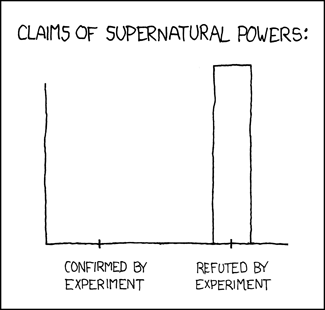
Supernatural? Really?

Digg!

Friday, January 18, 2008

What is peer review, really?

I am currently writing a manuscript for publication in a peer-reviewed molecular biology journal. And I’m hating it (just a little). Hopefully I’ll have this out of my hair in just a few more weeks. But it occurred to me, not all of my readers are scientists (indeed, based on the commenters alone, I would say that only a few of my readers are scientists). It occurs to me that not all of my readers know exactly how peer-review works – and why it’s the best game in town for verifying scientific work (well, aside from replication of the results by an independent lab).

So I thought I would write a little bit about how it works from the inside. The experiments that I’m writing about have been conducted over the last several years by another post-doc in the lab and I. We were working on different problems, but as it turns out, together our data shows several neat things about a protein that we study.

So. He and I have spent the last several months fighting about what belongs in the paper, and what doesn’t. Sorting the wheat from the chaff. And if he doubts any of my experimental findings, I do extra experiments to convince him. And vice versa. So over the last few months we’ve hashed out a story that we think some folks will find interesting. And we’ve managed to convince each other that this story is probably true.

But it doesn’t stop there. Next, I’ve been writing off and on over this time (and much more intensively more recently). I’ve also organized and integrated our data together into figures that are more intuitive than if I presented our data as it arrived chronologically. I gave a lab meeting just before Christmas, and had everyone in the lab look at the figures. As it happens, they hated them. They found them unclear, and at times, unconvincing. So I added a couple of experiments, and removed a couple that folks found unconvincing (so now I won’t make a couple of the conclusions I wanted to make – but I can do more on that later, and put it into a different paper).

I’m nearly at the point where I’ll hand out the manuscript and heavily revised figures to a few folks that I think are talented. These aren’t folks who are going to say, “Yes, Dr. Dr. Factician, this is the most brilliant piece of work I’ve ever seen” or “I agree with you 100%, you brilliant hunk of man, you!” Rather, I’ll hand it out to people who both don’t care what I think and have the intellectual fortitude to tear up the paper. Hopefully these folks will be ruthless with it, and help me make it into an even better paper.

After those revisions, I’ll give it to my advisor. I’ve only written one paper with her in the past. She is fairly particular about what goes and what doesn’t. More than likely, she’ll want to see 5 or more drafts of the paper before she’s happy (keep in mind, by the time she sees it, this paper will have been through more than 30 drafts).

After that, I clean up the paper one last time, checking for typos, casting about for logical errors, and off it goes to the journal. At the journal, it goes through 2 types of review. The first review is by the editorial staff. They will read the paper and decide if it’s proper material for their journal (i.e. topical) and if it’s sexy enough. There’s not much that I can do about sex appeal – that’s a pretty subjective area. Granted, I’ll try to make my work sound as interesting as possible, but hand it to 3 different people, 1 will say it’s Super-Sexy, 1 will say it’s interesting and 1 will say it’s banal tripe.

So, supposing I make it past the editor, it will be sent to 3 ad hoc reviewers. These are folks who are experts in my field. People in the position of my advisor (professors and the like at major medical schools). My advisor often gets me to review papers for her, so it’s possible my paper will get reviewed by post-docs, but it will be reviewed by people in my field. All 3 of them have to think that the paper is interesting and that the science is solid. Any one of them is sufficient to torpedo the paper.

Finally, if my paper is accepted, it will be printed in a journal for everyone to see. If there are problems with it, we will hear about it in other peoples’ papers. If it fits with other peoples’ data, and helps them to do other experiments in the field, they will cite my paper in their own papers, raising the visibility of my paper. (For example, my most successful paper has been cited 128 times).

So briefly, about a dozen people in my lab have criticized my work, and helped me make it better. Mrs. Factician has also played a large role in cleaning up my work. Several other scientists in my department will look at my paper. My advisor will read it and criticize it. An editor at the journal will read it and criticize it. Three ad hoc reviewers will read and criticize it. And finally, it will be placed in a journal, where many thousands of scientists can read and criticize it.

One bit of advice I give to starting graduate students: If you give your work to someone to read, and they say, “That was fantastic, don’t change a thing” you’re talking to the wrong person. You want the person who will say, “And on page 2, I can’t believe you started this sentence with the phrase X. It’s simply not true!”. Better to be criticized heavily by your colleagues close to home, and get your game in shape before sending it out for review.

Digg!

Friday beautiful science

Today's Friday beautiful science comes from the TaMaRa lab (the lab of Francois Taddei, Ivan Matic and Miro Radman). They've worked on a lot of different projects, but these photos are intended to demonstrate that bacterial colonies are not made up of homogeneous cells. The first photo is of:

Cells expressing RFP undert rpoH and YFP under rpoS-dependent promoters.
That is, they have RFP (red fluorescent protein) and YFP (yellow fluorescent protein) expressed under two different stress-dependent promoters. The colour of the cell will indicate which stresses that particular cell is being exposed to, protein folding stress, or starvation stress. As you can see, this group of 'homogeneous' cells is far from - and different cells are experiencing different stresses, depending on their position within the microcolony.

This second photo is of a
microcolony formed from a single cell (as above) with sublethal mytomycin concenration. Brightest cells (center) stopped growing after 3rd division and were engulfed by dividing cells.
It is merely intended to show that different cells are responding to a sublethal dose of a DNA-damaging agent in different ways. This lab does all kinds of exciting work. I'll try to post on them more in the future.


P.S. I apologize for my absence. I had a massive hard drive meltdown a couple weeks ago, and I'm still recovering from it. I'm currently working on an ancient iMac while I wait for my machine to be fully repaired. Posting should pick up again shortly.

Digg!

Wednesday, January 16, 2008

Scientists for better PCR

Classic.

Digg!

Friday, January 4, 2008

National Academies and Evolution


The National Academies of Science of the US has just released yet another report about evolution. Keep in mind here, the National Academies members are the best scientists in the world. You get invited to join the National Academies after a long and distinguished career as a scientist. Their reports tend to be on the heavy side.

This report is written for regular folks. It's an introduction to evolution in no uncertain terms, and it also blasts creationists:

In the United States, various views of creationism typically have been promoted by small groups of politically active religious fundamentalists who believe that only a supernatural entity could account for the physical changes in the universe and for the biological diversity of life on Earth. But even these creationists hold very different views. Some, known as “young Earth” creationists, believe the biblical account that the universe and the Earth were created just a few thousand years ago. Proponents of this form of creationism also believe that all living things, including humans, were created in a very short period of time in essentially the forms in which they exist today. Other creationists,known as “old Earth” creationists, accept that the Earth may be very old but reject other scientific findings regarding the evolution of living things.

No scientific evidence supports these viewpoints. On the contrary, as discussed earlier, several independent lines of evidence indicate that the Earth is about 4.5 billion years old and that the universe is about 14 billion years old. Rejecting the evidence for these age estimates would mean rejecting not just biological evolution but also fundamental discoveries of modern physics, chemistry, astrophysics, and geology.

Some creationists believe that Earth’s present form and the distribution of fossils can be explained by a worldwide flood. But this claim also is at odds with observations and evidence understood scientifically. The belief that Earth’s sediments, with their fossils, were deposited in a short period does not accord either with the known processes of sedimentation or with the estimated volume of water needed to deposit sediments on the top of some of Earth’s highest mountains.
Well said.

The report is well-written, and well placed. (And is clearly intended to mollify believers that there needn't be any conflict between science and faith). But this is probably a good choice on the part of the National Academies, as clearly their intent is to improve American science education:
The pressure to downplay evolution or emphasize nonscientific alternatives in public schools compromises science education.
This is the central point of the report. So go ahead. Download a copy of the report yourself (you need only provide them with your e-mail address). Send it to the members of your school board. Send it to your creationist aunt. Share it. Get it out there.

Digg!

Thursday, January 3, 2008

Cancer cured!


From Ataraxia.

Digg!

77th Skeptics' Circle

The 77th Skeptics' Circle is up at White Coat Underground. Go take a gander.

Digg!

Wednesday, January 2, 2008

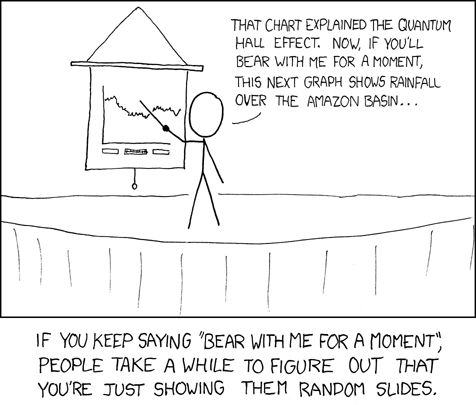
Bad talks

Digg!