Saturday, March 31, 2007

How does a scientist determine causation?


After talking it over with Mrs. Factician (who is also a molecular biologist), I realized that yesterday's post might not have made sense to everyone in the way it does to me. I would like conspiracy factory to be more than a place where scientists whine to each other that no one understands us. I'd like it to be educational to folks who don't do science every day. I'd like people like my Mom to come here and read it and find something useful for their day.

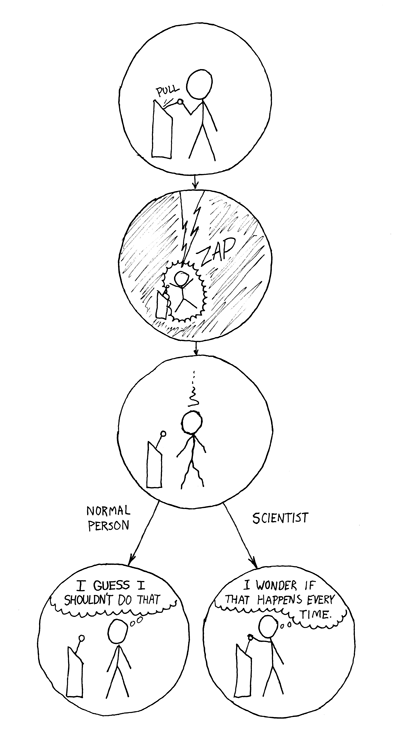
That said, I'm going to spell out the comic a little better. For those of you who are skeptics/scientists, this may seem a little like explaining a joke (if you have to explain it, it's not funny). But it should be educational, too. So go over, look at the comic, and come back if you have to. What does it have to do with autism? The joke is that scientists don't immediately assume causation if two events occur close together. The fact that the scientist gets zapped by lightning immediately after pulling the lever doesn't necessarily mean that the lever caused the lightning. (Granted, it may have caused the lightning, but until you've seen it multiple times under controlled conditions, you can't say for sure). Of course, doing an experiment that involves being shocked by lightning certainly wouldn't be performed by a scientist. It would be performed by her graduate student. ;)

What does this comic to do with autism? As it happens, the folks who claim that vaccines cause autism mostly rely on the fact that autism begins to show its ugly head around 2 years of age, right after children get a series of booster shots for their vaccines. Does this mean that vaccines cause autism? No. Especially once you realize that autistic children present with autism around 2 years of age whether they've had vaccines or not. It just happens that these things coincide in time with each other.

An experimentalist who wants to ask the question: "Do vaccines cause autism?" would examine a large group of children who get the vaccine and a large group of children who don't (who otherwise are living in similar circumstances) and see if a similar frequency of children get autism in both groups. As it happens, several groups have done this (National Academy of Sciences summarizes the studies here). And they do see similar frequencies. This pretty much kills the argument. (To further extend the analogy to the comic, this would mean that the scientist who pulls the lever a thousand more times would never get shocked again).

Digg!

Friday, March 30, 2007

How science works: subtitled autism isn't caused by thimerosal


I spent a little time reading David Kirby's conspiracy mongering at the Huffington Post today. Apparently "main-stream" scientists, doctors, the CDC, philanthropists, and the pharmaceutical industry are all in on a conspiracy to make sure that children get autism. *sigh* Anyway, I was going to write a post about the difference between anecdotal and real data, but instead I give you this approximation from the nice folks at xecd.com.

Digg!

Thursday, March 29, 2007

Friday beautiful science

Today's image is of:

"A microplankton sample pulled from the depths of the Antarctic Sea was captured by a scanning electron micrograph."
with false color applied. This photo won an honorable mention in 2004 at the NSF's Science & Engineering Visualization Challenge. Taken by Dee Breger, you can see more images here. Happy Friday.

Digg!

57th Skeptics' Circle

This week the Skeptics' Circle is up at Aardvarchaeology. Take a gander.

Digg!

Wednesday, March 28, 2007

GM crops and bees, an addendum

At the moment, Colony Collapse Disorder (and this Spiegel article particularly) are causing a minor storm on the blogosphere. Many of the blogs are being fairly uncritical in their condemnation of GM-corn, with knee-jerk reactions predominating over reasonable analysis.

I found some interesting stuff from the Colony Collapse Disorder Working Group. This is a group of entomologists based out of Penn State that are trying to figure out why the bees in North America and Europe are dying. They're not quite as hysterical about the die-off as the conspiracy theorists at Spiegel:

During 2006, an alarming number of honey bee colonies began to die across the continental United States. Subsequent investigations suggest these outbreaks of unexplained colony collapse were experienced by beekeepers for at least the last two years. Reports of similar die offs are documented in beekeeping literature, with outbreaks possibly occurring as long ago as 1896. The current phenomenon, without a recognizable underlying cause, has been tentatively termed “Colony Collapse Disorder” (CCD), and threatens the pollination industry and production of commercial honey in the United States.
They have a number of likely suspects:
What potential causes of CCD is the Working Group investigating? The current research priorities under investigation by various members of the CCD working group, as well as other cooperators include, but is not limited to:
• Chemical residue/contamination in the wax, food stores and bees
• Known and unknown pathogens in the bees and brood
• Parasite load in the bees and brood
• Nutritional fitness of the adult bees
• Level of stress in adult bees as indicated by stress induced proteins
• Lack of genetic diversity and lineage of bees
but consider GM-corn (BT-corn) to be an unlikely suspect:
What are examples of topics that the CCD working group is not currently investigating?

GMO crops: Some GMO crops, specifically Bt Corn have been suggested as a potential cause of CCD. While this possibility has not been ruled out, CCD symptoms do not fit what would be expected in Bt affected organisms. For this reason GMO crops are not a “top” priority at the moment.

Radiation transmitted by cell towers: The distribution of both affected and non-affected CCD apiaries does not make this a likely cause. Also cell phone service is not available in some areas where affected commercial apiaries are located in the west. For this reason, it is currently not a top priority.
Now conspiracy theorists may point out that the working group hasn't completely ruled out BT-corn, but it is rather compelling that they have examined the deaths of these bees, and decided their deaths don't fit the symptoms expected by BT-poisoning. (Rather akin to finding a bullet hole in a corpse, and concluding that the person likely wasn't strangled).

Digg!

Tuesday, March 27, 2007

Genetically modified crops are responsible for bee deaths? I don't think so...

An article from last week in Spiegel is just so breathtakingly stupid it begs to be commented on. The article: Are GM Crops Killing Bees? suggests that there is a link between the declining bee population and the introduction of GM crops, shows data that makes the answer clear (the answer is no) and continues merrily along, ending the article as if there is some doubt about what the answer is.

A bit of background is in order. Over the last decade, bee populations in the U.S. and Europe have been dropping. The last year has seen particularly large drops in commercial bee-keepers. The Spiegel article cites rates as high as 70%, though these numbers are cited for individual beekeepers. It's unclear from the article what the overall drop rate has been, and though they cite differences between the U.S. and Europe, it's hard to tell if these are meaningful because they're only citing the losses of individual beekeepers.

The bee die off is particularly important for our agriculture, as many of the flowering plants require bees to pollinate their flowers to make fruit. Loss of bees could result in major decreases in the production of flowering crops.

So what does this article say? These drops coincide with the introduction of genetically modified-insecticide producing corn, so this corn must be to blame. This is not a bad hypothesis. One could imagine that bees that find their way onto the corn might ingest some of the compound. However, let's look at the data. Germany has some pretty strict laws about introduction of genetically modified (GM) crops. GM crops made up less than one tenth of 1% of all crops grown in Germany, whereas almost all corn grown in the U.S. is genetically modified to produce the BT-insecticidal protein. So, if GM crops are to blame, one would expect bees in Germany would largely be spared the die off seen in bee colonies in the U.S. Sadly, this is not the case. German bees are dieing off at appreciable rates as well (though granted, at somewhat lower the rates than seen in the U.S. if you trust that the Spiegel numbers are representative). Game over. The fact that both countries are losing bees at high rates clearly demonstrates that GM crops are not to blame.

The National Academies of Science of the U.S. have looked into the bee die off (and have proposed spending more effort looking into it - it has serious economic consequences). Their main conclusions? Non-native mites have been responsible for a large number of deaths, as well as antibiotic-resistant bacterial pathogens (who knew? people treat their bees with antibiotics?). Their recommendations are for increased investment in bee-breeding, to allow creation of pathogen and mite-resistant bees.

Digg!

Monday, March 26, 2007

Infophilia: Convenient Myths

I've been intending to write a post about global warming myths for two months already, but have found myself too busy with other things. So instead, I point you to this good post here: Infophilia: Convenient Myths.

Digg!